Skiathos is a magical island: crystal-clear blue water, beaches all the way around the coast, and rich green nature everywhere. Skiathos town and every village have an atmosphere of their own, and each corner of the island is worth exploring while you stay.
Bourtzi
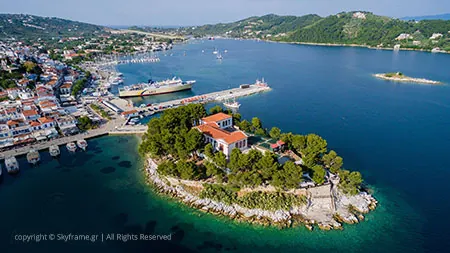
Bourtzi is the small peninsula that divides the port of Skiathos in two. It was once a fort, built by the Ghisi brothers who took Skiathos in 1207, with walls, battlements and embrasures, and a round tower on each side of the gate. The ruins that remain don’t show how tall the walls once were.
Today Bourtzi is a rare place to unwind: full of pine trees, always fresh and cool, with a magnificent view. The old primary school has become a picturesque cultural centre, with conference rooms and a lovely summer theatre that hosts plays and concerts every summer.
Evangelistria Monastery
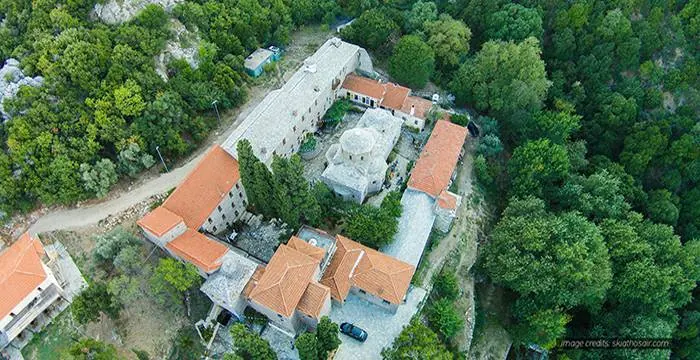
Deep in the greenery of the Lekhounio gorge, beside the springs at Agalianos and below Karaphlytzanakia, the highest peak on Skiathos, stands the Monastery of the Annunciation of the Virgin: Evangelistria, or Vangelistria as Skiathians call it.
Building began in 1794, by a group of kollyvades monks who had left Mount Athos during the disputes over holding memorial services on Saturdays rather than Sundays. Their leader was the monk Niphon, born in 1736 in Patrika on Chios. Among them was a Skiathian, Gregorios Hadjistamatis, who had inherited a large estate on the island and persuaded Niphon to found the new monastery here. It was completed in 1806 and became the centre of the kollyvades movement, whose spirit deeply influenced island life and the Skiathian writers Alexandros Papadiamantis and Alexandros Moraitidis.
The monastery gave important moral and material support to the movements before and during the revolution of 1821. It was here, in 1807, that the first Greek flag with a white cross on a blue field was designed, woven, blessed and raised, and on it Father Niphon swore in fighters including Theodoros Kolokotronis, Andreas Miaoulis, Papathymios Vlachavas, Giannis Stathas and Nikotsaras. The philosopher-priest Theophilos Kairis was confined to the monastery after his conviction by the Holy Synod in 1839.
Papadiamantis House
Alexandros Papadiamantis, one of the great writers of modern Greek prose, was born on Skiathos on 4 March 1851, the son of a priest, and the island runs all through his work. He went to Athens to finish school and enrolled in philosophy at the University of Athens without completing his degree, and lived very modestly from his writing: journalism, short stories and serialised novels. Later in life he returned to Skiathos, where he died.
The house where he was born no longer exists. He grew up, and died, in the house his father built in 1860, as an inscription in one of its walls records. It stands about 100 metres inland from the eastern waterfront of the town, in a narrow dead-end lane off today’s Papadiamanti Street.
It is a simple, austere island house. The small room on the right was first his father’s room for his books and vestments, and later Alexandros’ bedroom and study, like a monastery cell with a window, a built-in cupboard and a narrow bed. Opposite the entrance is the living room, whose only decoration is a coloured diamond pattern on the ceiling. Visitors enter the house-museum by an external wooden staircase.
Kastro
Around the middle of the 14th century, constant pirate raids drove the people of Skiathos to move their town to Kastro, a natural fortress on a headland in the north of the island. They strengthened it with tall walls full of embrasures and cannons facing the land. A wooden drawbridge joined the gate to the hill opposite and could be pulled in when enemies came, and above the outer gate a terrace held the zematistra, a cauldron of boiling water for unwelcome visitors.
Kastro was Byzantine until 1453, Venetian until 1538 (and again briefly around 1660) and Ottoman until 1821. Life inside was hard: besides the pirates and would-be conquerors, space was so short that the houses were tiny and packed together. Even so, there were more than twenty churches, a mosque without a minaret and water cisterns, with the cemetery outside the walls.
Kastro was abandoned in 1830, after the founding of the Greek state. Two churches survive: Agios Nikolaos and Christos sto Kastro, the Nativity of Christ, the cathedral of the medieval town, a 17th-century basilica with a timber roof, fine frescoes and a carved wooden iconostasis of 1695, much loved in the Christmas stories of Papadiamantis and Moraitidis. The half-ruined church of Panagia Preklas, part of the wall with the gate, the terrace with its zematistra, the ruined mosque, two cisterns and a cannon remain too. Wild natural beauty and history together make Kastro the most important site on Skiathos.
See it for yourself
Book your stay at Magic Hotel, in the middle of the island.